...

Language:

Currency:

PLN

Do you require a refrigerant recovery station? Technical analysis and HVACR service technician responsibilities

Legal requirements and environmental standards

In light of current F-gas regulations (EU Regulation No. 517/2014 and amendment 573/2024), every service technician working with fluorinated greenhouse gases (HFCs) is required to:

  • recover refrigerant from the system during repair, modernisation or dismantling
  • document the recovered refrigerant
  • transfer it for regeneration or disposal

The lack of a recovery station results in a violation of environmental regulations and may lead to administrative penalties, including the loss of the F-gas certificate. The recovery requirement also applies to equipment containing refrigerants such as R-404A, R-410A, R-134a, R-448A, R-4

When should a refrigerant recovery station be used?

The use of a recovery station is necessary in situations such as:

  • replacement of a compressor, evaporator or condenser
  • complete emptying of the system before filling with new refrigerant
  • dismantling of a refrigeration or air conditioning system
  • leak tests requiring the removal of refrigerant from the circuit
  • servicing systems with flammable refrigerant (e.g. R-32), where recovery must be carried out in accordance with safety rules

Technical benefits of having your own recovery station

For service technicians who regularly perform refrigeration and air conditioning work, having their own recovery station means:

  • guaranteed compliance with legal regulations
  • the possibility of reusing refrigerant and reducing financial losses
  • a reduction in the risk of environmental pollution and contact with hazardous vapours
  • independence from external equipment rental companies

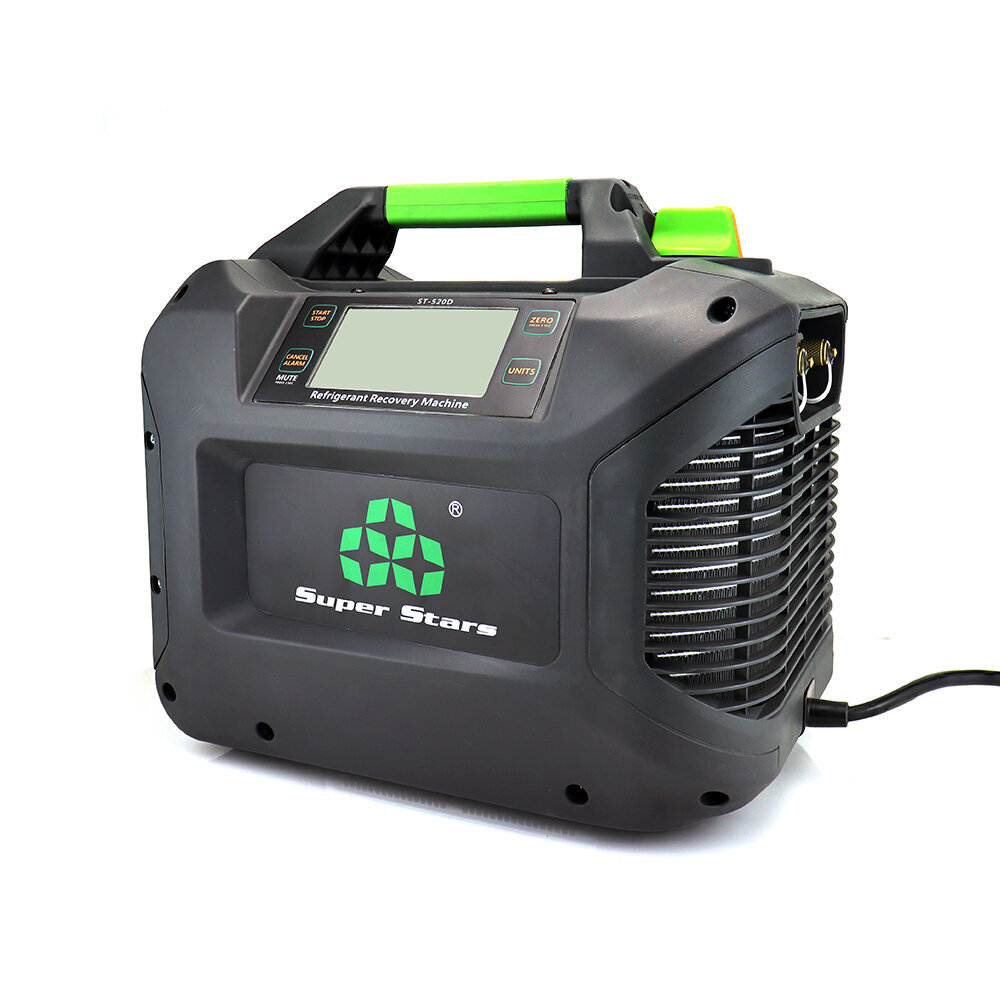
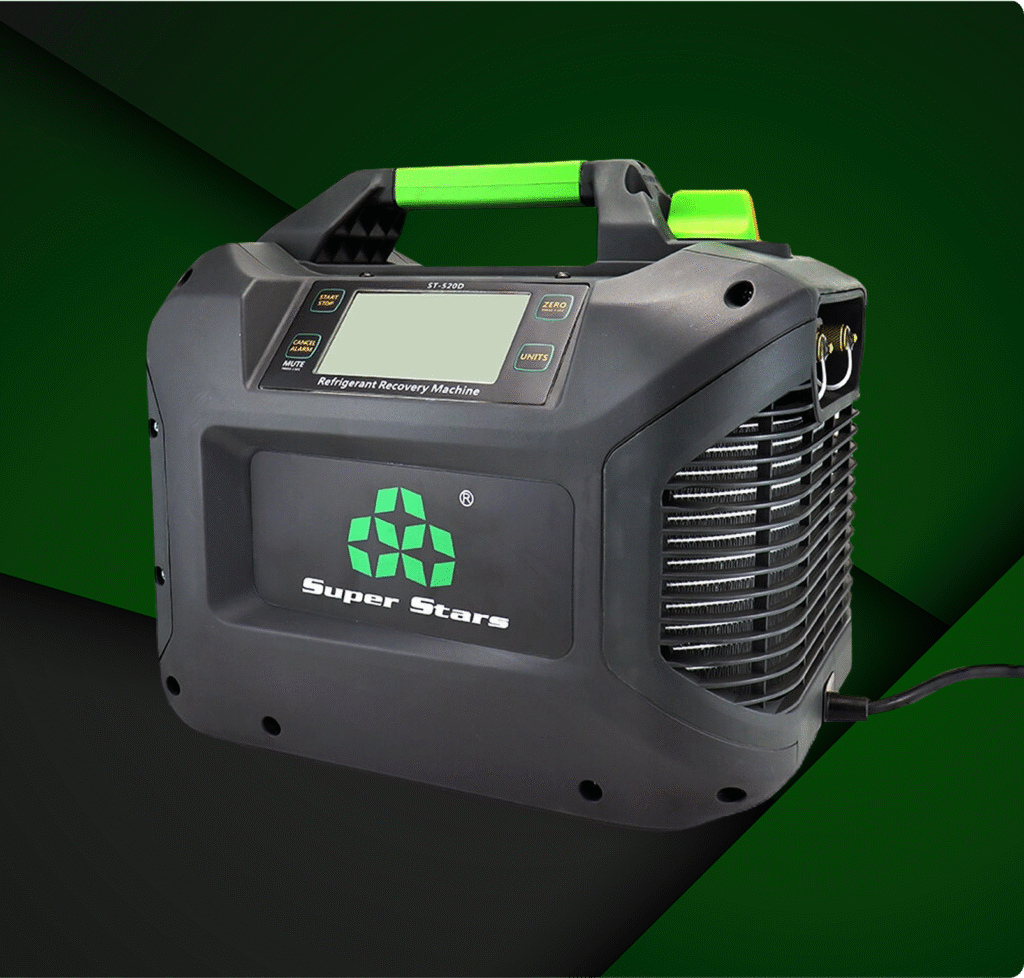
ST-520D – SUPER STARS refrigerant recovery station

Professional tool for HVACR service technicians

The ST-520D model has been designed for professional applications in refrigeration, air conditioning and heat pumps. This device combines high recovery efficiency with a compact and mobile design.

Supported refrigerants

The station is compatible with the most popular HFC and HFO refrigerants, including:

  • R-22, R-134a, R-404A, R-407C, R-410A
  • R-507, R-32, R-448A, R-449A
  • and others from group V (including mixtures)

Thanks to its CE certification and compliance with European standards, the ST-520D meets the requirements of current F-gas regulations.

Key technical parameters of the ST-520D

ParameterValue
Compressor typePiston, oil-free
Recovery speed (push-pull)Up to 9.5 kg/min (group V refrigerants)
Work modesSteam and liquid recovery, push-pull mode
Power supply230 V / 50 Hz
DisplayElectronic LCD with status icons
Safety valvesYes
Weight14,5 kg
Dimensions400 × 240 × 330 mm

Thanks to its push-pull recovery mode, the device significantly reduces the time needed to empty large refrigeration systems. Its spark-free design (no components that could generate ignition) ensures safety when recovering flammable refrigerants such as R-32.

Functionality and ergonomics

  • Compact housing with carrying handle – ideal for mobile work
  • Electronic LCD display allows real-time process control
  • Multitasking – one device for both air conditioning and refrigeration systems
  • Service valve with automatic shut-off function – increases safety and convenience

Who is the ST-520D station intended for?

The device is recommended for:

  • air conditioning service technicians (split, multisplit, VRF)
  • refrigeration technicians servicing commercial equipment (refrigerated counters, cold rooms)
  • heat pump installers performing servicing and upgrades
  • HVACR companies performing refrigerant recovery and regeneration in accordance with F-gas regulations

Conclusion

In the face of growing environmental requirements and stricter regulations, having your own refrigerant recovery station is no longer a matter of choice – it is an essential part of the technical infrastructure of every HVACR company.

The SUPER STARS ST-520D model offers:

  • high recovery speed
  • wide compatibility with refrigerants
  • mobility and reliability in everyday use

Check out the details and order the ST-520D station:

SUPER STARS ST-520D recovery station

Udostępnij:

Przeczytaj również

Digital or analogue pressure gauges – which ones to choose for refrigeration and air conditioning servicing?

Essential tool for HVACR service technicians

In everyday work with refrigeration, air conditioning or heat pump technology, a set of pressure gauges is an absolute must-have piece of equipment. It allows you to:

  • measure the refrigerant pressure on the suction and discharge sides,
  • diagnose overheating and overcooling,
  • detect leaks,
  • assess the correct operation of the compressor and the entire system.

Correct pressure gauge readings translate into installation efficiency, safety and compliance with F-gas regulations. The key question is: should you choose digital or analogue pressure gauges?

In this article, we compare both types.

Construction and principle of operation

Analogue pressure gauges

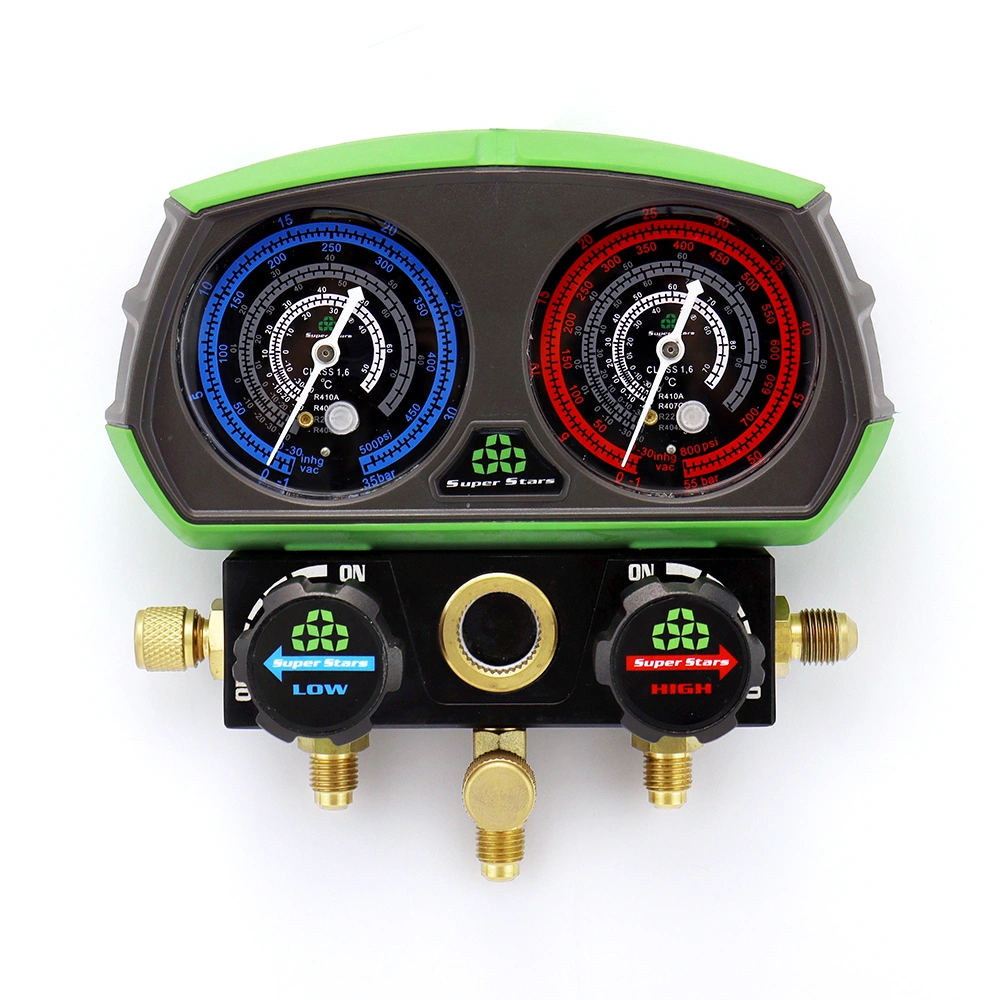
These are classic mechanical devices based on a Bourdon tube. The pointer moves along a calibrated dial (bar/psi) under the influence of pressure.

A typical analogue set includes:

  • two pressure gauges (low and high pressure),
  • shut-off valves,
  • hoses with quick couplings,
  • a case or mounting panel.

Example: ST-B2801 analogue pressure gauge set

Digital pressure gauges

They use electronic sensors (MEMS or piezoresistive) that convert the pressure value into an electrical signal and display the result on an LCD/LED screen. Modern digital pressure gauge sets are often advanced measuring stations with the following functions:

  • automatic refrigerant selection,
  • temperature measurement (external probes),
  • overheating and overcooling calculation,
  • data logging,
  • Bluetooth or USB connectivity.

Example: ST-B268D digital pressure gauge set

Digital vs analogue pressure gauges – practical differences

Work ergonomics

  • Analogue – simple, quick to use, no power supply required. Ideal for basic servicing and quick checks.
  • Digital – require configuration and a power supply, but offer significantly greater diagnostic capabilities.

Handling refrigerants

  • Analogue – limited to several refrigerants (e.g. R-134a, R-404A). Working with a different refrigerant = need to replace the pressure gauge.
  • Digital – built-in database of dozens or even hundreds of refrigerants, including modern replacements for R-404A:
    • R-448A
    • R-449A
    • R-452A

Automation and precision

  • Digital pressure gauges automatically calculate overheating, vacuum and pressure differences, eliminating human error.
  • Analogue gauges require manual calculations from pressure-temperature tables.

Advantages of analogue pressure gauges

  • No electronics = lower risk of failure
  • Ready to operate without batteries
  • Good weather resistance
  • Lower purchase cost

Disadvantages of analogue pressure gauges

  • Limited number of factors
  • Lower accuracy
  • No diagnostic functions

Advantages of digital pressure gauges

  • Supports multiple refrigerants (including R-404A replacements)
  • Accuracy to 0.1 bar or better
  • Functions: temperature, superheat, vacuum, logging
  • Easy-to-read display

Disadvantages of digital pressure gauges

  • Require power supply
  • Higher cost
  • More susceptible to damage

What to choose for refrigeration and heat pumps?

Analogue pressure gauges are suitable when:

  • you perform quick inspections and servicing,
  • you work in difficult conditions (damp, cold),
  • you teach the basics in workshops and technical schools.

Digital pressure gauges are a better choice when:

  • you work with various refrigerants, including new substitutes,
  • you service heat pumps and inverter systems,
  • you care about precise analysis of overheating and overcooling.

In practice, many service technicians use both solutions – analogue as a quick field tool and digital for accurate diagnoses.

Recommended pressure gauge models

  • Analogue ST-B2801 set – durability and simplicity for everyday service.
  • Digital ST-B268D set – high precision, extensive range of factors and robust housing.

Check out our range of refrigeration pressure gauges and choose the best tool for your job!

See all pressure gauges →

FAQ – frequently asked questions

What is the difference between a digital pressure gauge and an analogue one?

A digital pressure gauge offers greater precision, support for multiple factors, and diagnostic functions. An analogue gauge is simpler and more resistant to weather conditions.

Do digital pressure gauges support R-448A and R-449A refrigerants?

Yes, most modern models have over 100 factors in their database, including R-404A replacements such as R-448A, R-449A and R-452A.

When is it better to choose analogue pressure gauges?

When you work in harsh conditions (e.g. outdoors in winter), you need a simple and reliable kit without batteries.

Is it worth having both types of pressure gauges?

Definitely yes – analogue for quick measurements, digital for accurate analysis and modern installations.

Porównywarka

Nie dodałeś jeszcze produktów do porównania
Seraphinite AcceleratorOptimized by Seraphinite Accelerator
Turns on site high speed to be attractive for people and search engines.